The assistant compresses before the real task is fully shaped.
Adaptive Depth and Mode
A protocol for controlling depth, preserving signal, and reducing noise.
For everyday chat, structured tasks, and deeper analysis when needed.
A.D.A.M. is a spec-first control layer for AI chat: rule-ordered routing, bounded audit, explicit depth transitions, and more disciplined behavior under ambiguity.
- Manual override before semantic drift
- Structural kernel as SSOT
- More disciplined behavior under ambiguity
Depth expands before it becomes useful.
The assistant closes cognitive gaps with its own assumptions before the missing parts are made explicit.
Start here
Use the live protocol from the repository.
A.D.A.M. runs as a protocol file loaded into your chat host instructions.
1. Open the repository
Use the repository as the live public surface of the project.
2. Use the canonical file
A.D.A.M.v5.txt is the canonical protocol file.
3. Load the protocol
Either upload the file to your normal chat host or paste its contents as system instruction.
4. Bootstrap correctly
To bootstrap correctly, send ADAM PING twice at the start.
5. Start the session
After the second ADAM PING, send your task.
Primary entrypoint: A.D.A.M.v5.txt
Why it exists
Stable depth is a routing problem.
A.D.A.M. separates lexical routing, structural inference, and publish-boundary validation. That is what makes it feel less improvisational and more like a protocol artifact.
Manual override
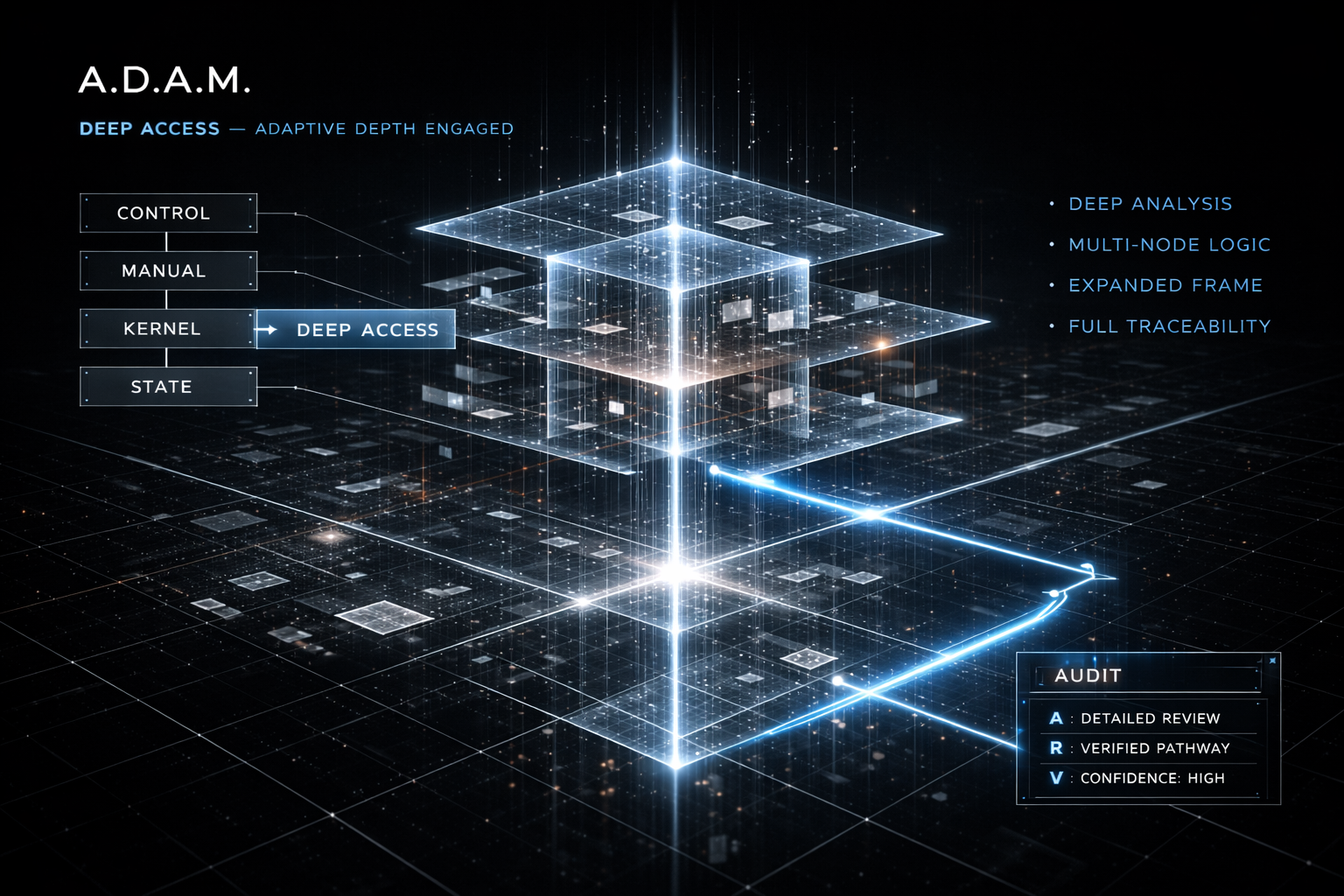
LOW, MID, and DEEP are explicit control surfaces, not suggestions hidden inside prose.
DEEP explain this briefly
Structural kernel
Depth candidates come from shape and constraints, not vague intent guessing.
2+ options + criteria -> POSSIBLE DEEP
Bounded audit
Audit is visible only when needed, rigid when active, and never allowed to balloon.
AUDIT / ACTION / RISK / BASIS
Fail-closed behavior
If the host cannot satisfy the contract, the protocol fails in visible, rule-bound ways.
ADAM_UNSUPPORTED
See it work
Not a moodboard. A behavioral surface.
Input
User:
Compare A) and B)
Budget: 100
Need:
- speed
- reliability
- low waste
Output
MODE: MID -> POSSIBLE DEEP
TRACE INPUT: [constraints] [numbers, dates or limits]
Compact recommendation...
AUDIT
ACTION: ...
RISK: ...
BASIS: ...
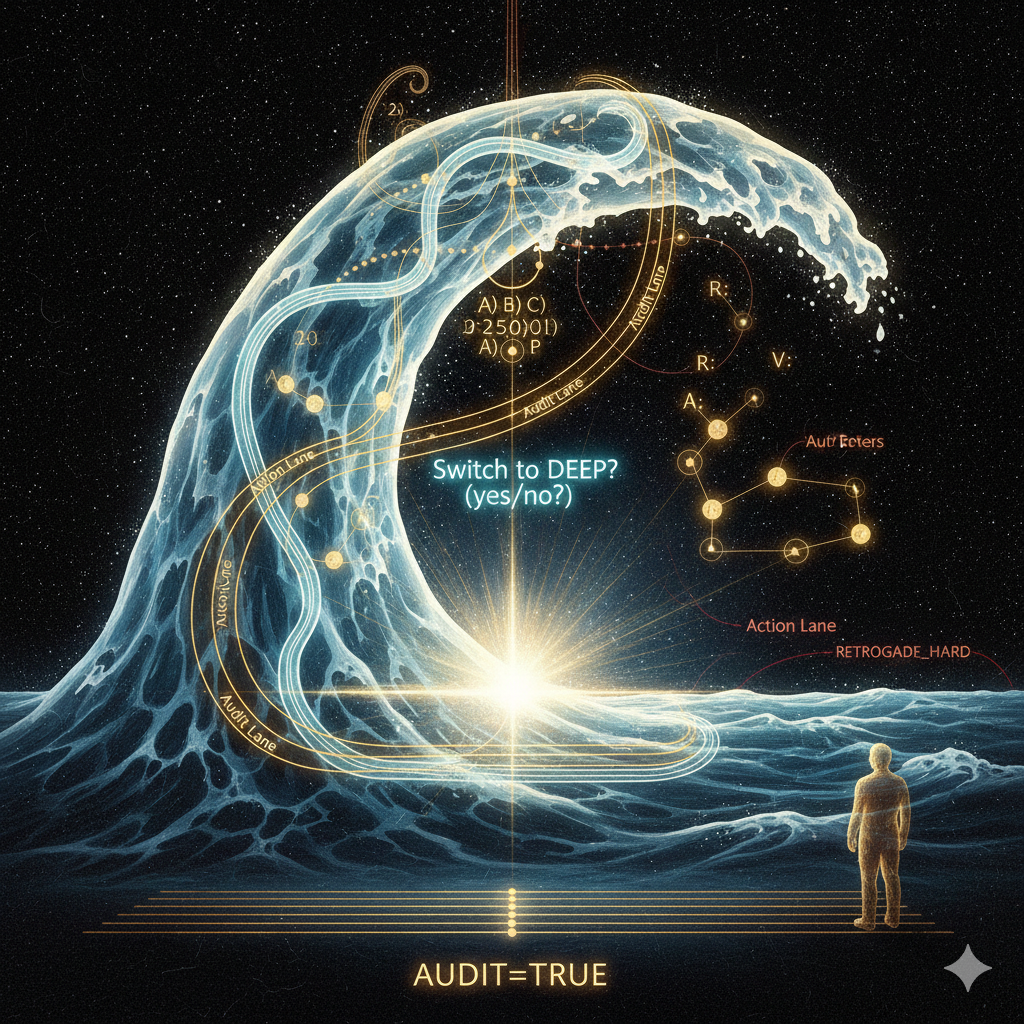
Switch to DEEP? (yes/no)
Explicit depth
When depth matters, A.D.A.M. makes the transition visible.
Deep mode is not a vague "think harder" gesture. It is gated, surfaced, and bounded: a deliberate handoff from routing into expanded analysis, with audit still kept under contract.
- DEEP is explicit or manually forced
- Audit remains bounded even under expansion
- Tracing stays readable instead of theatrical

Bounded audit
When uncertainty rises, visibility rises with it.
Audit in A.D.A.M. is not decorative introspection. It is a constrained surface for action, risk, and grounding basis, kept short enough to stay operational under pressure. ACTION, RISK, and BASIS stay bounded and operational.
- Audit appears only when the contract says it should
- Action, risk, and basis stay bounded and readable
- Retrograde pressure does not silently inherit stale commitments

Built for real host behavior
Uploads can be inline, side-channel, polluted, or broken.
A.D.A.M. is designed around actual host friction: boot guards, explicit probes, degraded transports, strict command matching, and strict fallback behavior.
BOOT_GUARDS
Whitespace-only, spec echo, metadata-only upload.
CONTROL PATH
Commands and overrides resolved lexically before semantic interpretation.
OUTPUT CONTRACT
Final text validated at the publish boundary.