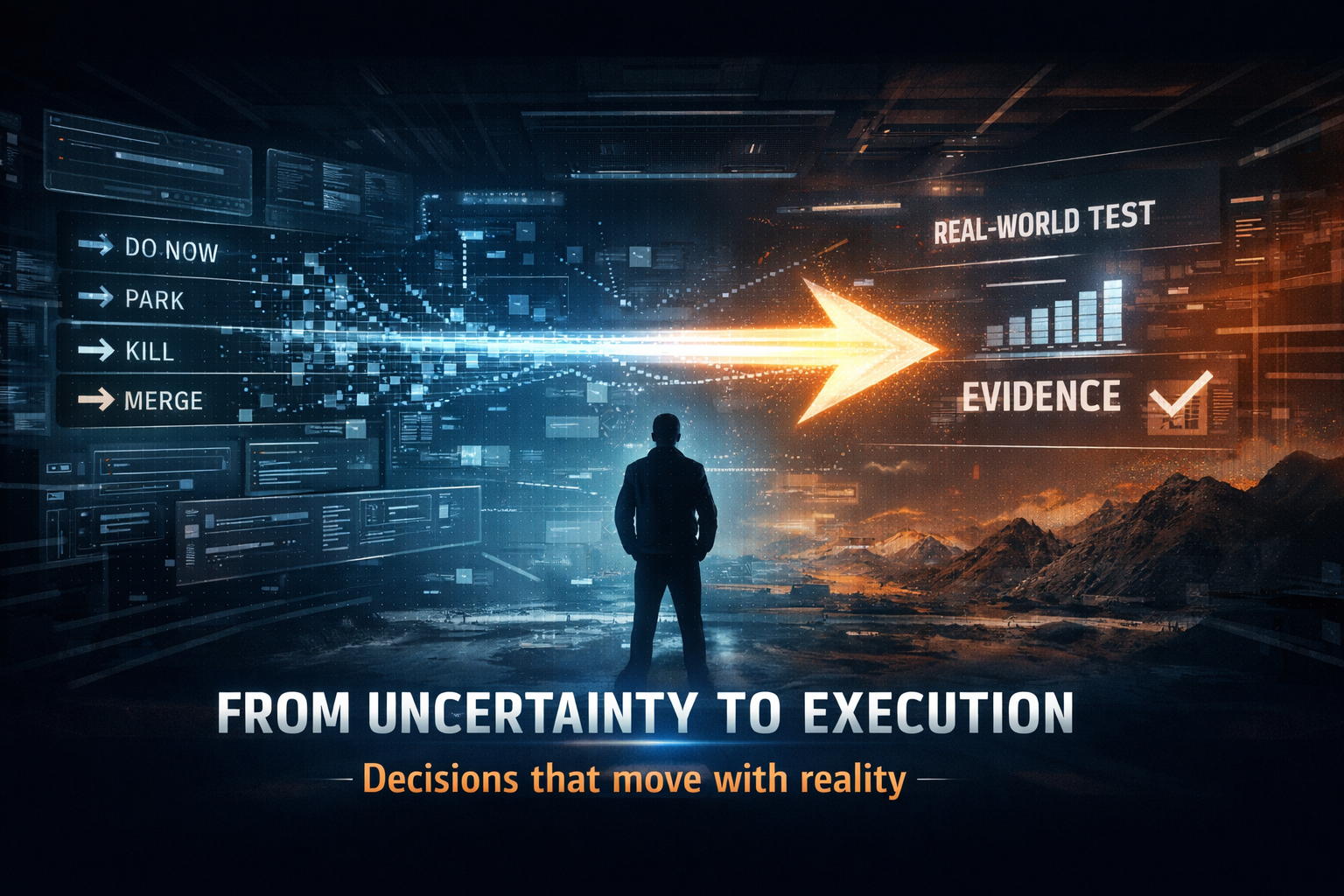
No endless discussion loops. The protocol closes to a verdict.
PLUTONIUM-like Adversarial Peer Validation Protocol
Close decisions. Do not debate forever.
PA_PVP is a copy/paste decision protocol for movement under uncertainty: clear verdicts, one executable next action, reality probes, bounded uncertainty, and less drift.
Successful first run: a verdict in [QUEUE], one [NEXT], and a readable [HUMAN_TABLE].
- Clear verdict: DO NOW / DO LATER / DISCARD
- One next action, not a pile of options
- Reality probes when simulation stops being enough
Why it exists
Doubt should generate motion, not delay.
Most decision systems fail in one of three ways: they keep debating, they simulate certainty, or they produce a list instead of a trajectory. PA_PVP is built to break all three failure modes.
When internal evidence is weak, the protocol escalates to probes or parks cleanly.
If the next step does not reduce uncertainty or change the world, the run is invalid.
What the protocol does
Pressure-testing in service of execution.
PA_PVP does not try to sound wise. It takes a plan, artifact, or target and converts it into critique, a verdict, reusable state, and a short executable path.
Forced verdict
Every valid run ends in a clear decision: DO NOW, DO LATER, or DISCARD.
Executable next
The protocol must return one next action, not an essay or a motivational summary.
Probe-first honesty
If confidence is fragile, PA_PVP forces a real-world test or parks instead of pretending.
Rule-bound debt
Near misses, open uncertainty, and circular dependencies become constraints, not loose notes.

Surface
The output is meant to move something.
Input
<<<I id=E1 title="Short title">>>
<<<PLAN>>>
- ship X
- remove Y
- deploy by Friday
<<<END>>>
Output
STATE: DECISION.TEST.FINAL
[QUEUE] ... gate: ...
verdict: DO NOW
[NEXT] run the smallest useful check
[STEPS] max 5 atomic moves
Evidence inside the loop
Start with what is available. Ask only when allowed.
The default switch is AskUser = OFF. When available evidence is not enough,
PA_PVP either simulates cautiously, parks cleanly, or, if allowed, asks for one minimal real-world input.
- Paste-back continuation
- One minimal probe instead of speculative certainty
- Open uncertainty tracked across iterations

Start here